
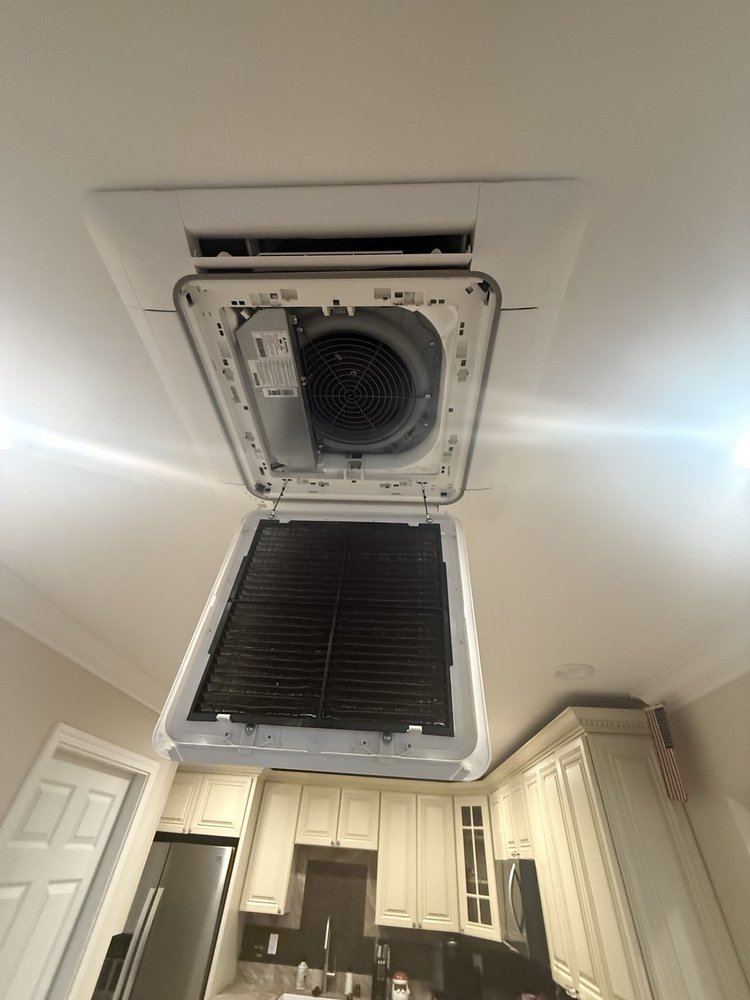
When most people say “Mitsubishi mini-split,” they mean the white wall-mounted unit. Fair enough, it’s the one everybody sees. But Mitsubishi builds five distinct indoor unit styles, they can all share a single outdoor condenser, and picking the right style per room is most of what separates an install you love from one you tolerate. Here’s the lineup the way I walk customers through it at an estimate.
1. Wall-mounted units (MSZ series)
The classic. Mounts high on the wall, costs the least, installs the fastest, and carries some of the best efficiency numbers in the whole lineup. Residential wall units run the MSZ designation and cover roughly 6,000 to 24,000 BTU per head.
Where it fits: bedrooms, offices, additions, garage conversions, any single room that needs its own comfort control and where a visible unit doesn’t bother you.
2. Ceiling cassettes (SLZ and MLZ series)
A cassette recesses up into the ceiling between the joists; all you see is a flat grille. The SLZ four-way cassette washes air in four directions and suits larger open rooms. The MLZ one-way cassette is the retrofit specialist: it’s dimensioned to slot into a standard 16-inch-on-center joist bay, which is exactly what you find in the older housing stock around the Bay. Plaster walls stay untouched.
Where it fits: living rooms, kitchens, and primary bedrooms where the owner wants the comfort without looking at equipment.
3. Multi-position ducted air handlers (SVZ and PVA series)
This is the one that surprises people at estimates. Mitsubishi’s SVZ and PVA air handlers connect to conventional ductwork, the same registers and returns your furnace uses today. They mount vertically or horizontally, in the same closet, attic, or garage spot where the furnace sat. The result looks and feels exactly like central heating and cooling, because it is; the heat pump is completely invisible in the living space.
Where it fits: whole-home conversions in houses with workable ducts, and anyone who wants a heat pump without a single visible indoor unit. This is the style we install most for full heat pump conversions.
4. Slim-duct units (SEZ and PEAD series)
A compact ducted unit that hides in a soffit, closet, or between floors and serves one to three nearby rooms through short duct runs. It’s the middle path: no wall units, no full duct system, just a small concealed unit and a couple of discreet registers.
Where it fits: a bedroom wing, an ADU, or a remodel where you want ducted comfort in part of the house without touching the rest.
5. Floor-mounted units (MFZ series)
Sits low on the wall near the floor, roughly where a radiator would. It solves the rooms the other styles can’t: knee-wall spaces under sloped ceilings, rooms with glass or window walls, and spots where nothing can hang high.
Where it fits: upstairs rooms in older two-stories, sunrooms, and any room where the high wall real estate is spoken for.
Mixing styles on one system
The part that makes the lineup genuinely flexible: one outdoor unit can run different indoor styles at once. A common Bay Area setup we install is a ducted air handler covering the bedroom wing, a cassette in the main living area, and a wall unit in the office over the garage. Each zone gets its own thermostat. The house gets one condenser outside.
The unit style is step two
Whichever styles end up in the mix, the sizing question comes first. An oversized head short-cycles, controls humidity poorly, and wears out sooner, and no unit style fixes that. Every install we quote starts with a Manual J load calculation for your actual house and climate zone, then the style conversation happens room by room.
We’re factory-trained on Mitsubishi M- and P-Series equipment and install all five indoor styles across the East Bay, Tri-Valley, South Bay, and the Peninsula. The in-home estimate for an installation is free, and rebate eligibility for your address (MCE, Ava, SVCE, Peninsula Clean Energy, BayREN) gets checked as part of it.
Key takeaways
- Mitsubishi makes five indoor unit styles: wall-mounted, ceiling cassette, multi-position ducted air handler, slim-duct, and floor-mounted. All five can combine on one multi-zone system.
- The ducted air handler (SVZ/PVA) is the one that surprises people: it replaces a furnace in the same closet or attic spot and runs your existing ductwork, so the heat pump is completely invisible.
- The MLZ one-way cassette is built to slot between standard 16-inch joists, which makes it the retrofit favorite in older Bay Area homes with plaster walls.
- Floor-mounted units solve the rooms wall units can't: knee walls, glass walls, and rooms where nothing can hang high.
- The unit style is step two. Step one is a Manual J load calculation, because an oversized head short-cycles no matter how good the hardware is.
Related questions
Can I mix different indoor unit styles on one system?
Which Mitsubishi indoor unit is cheapest?
I don't want to see any equipment on my walls. What are my options?
Do all of these work with the H2i hyper-heating condensers?
Are you a Mitsubishi Diamond Contractor?
Need help with your system? Call (925) 999-4095 or book a visit. Repair diagnostics are $99, credited toward the repair. Installation assessments are free.
Further reading
Need HVAC help in the Bay Area?
We serve 56 cities. Same or next day when we can.
Bay Area · 7am–7pm · 7 days · no overtime charges