
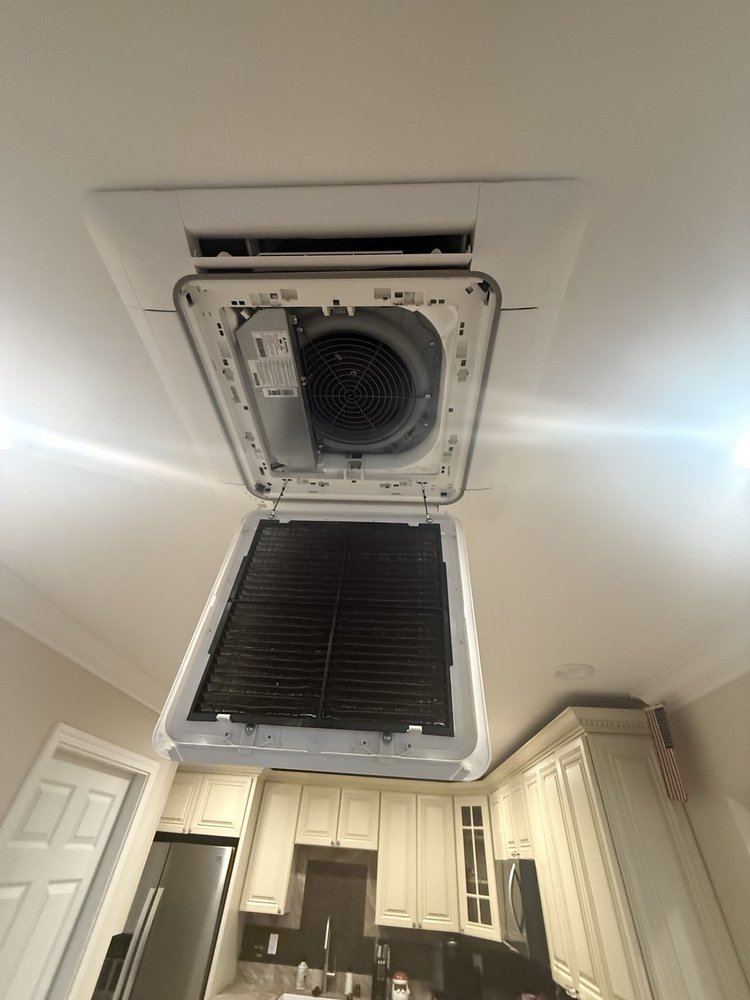
A lot of mini-split buying guides read the same way: a paragraph on each brand, a square-footage sizing chart, a rebate list that was accurate whenever it was written, done. That’s not enough to actually buy from. Here’s what three years of installing and servicing these systems in Danville, San Ramon, Walnut Creek, Oakland, Fremont, and everywhere between has taught us, plus the parts of ownership nobody puts in a buying guide.
What you’re actually choosing between
A mini-split is a ductless heat pump. One or more indoor heads, mounted on a wall, ceiling, or floor, connect through a small hole in the exterior wall to an outdoor condenser. No ducts, no attic runs, each zone controlled independently. If you want the full case for mini-split versus central AC first, we’ve written that up separately: Mini-Split vs Central AC.
The short version, honestly stated: mini-splits win when a home has no usable ductwork, when only certain rooms need conditioning, or when different rooms have wildly different loads that a single central system can’t zone for. Central wins when good ducts already exist. Both are real answers, not a sales pitch for one or the other.
Once you’ve decided ductless makes sense, the brand conversation starts. We install and service Mitsubishi, Daikin, and Fujitsu. Here’s what each is actually like.
Mitsubishi: field notes
We’re factory-trained on Mitsubishi’s M- and P-Series, having completed the Essentials course in Sacramento in May 2026 and the Advanced M- and P-Series Service course at Mitsubishi Electric’s Los Angeles factory training center in June 2026. We are not a Diamond Contractor. That’s a real, separate Mitsubishi program with its own requirements, we’re working toward it, and we’re not going to claim it before we’ve earned it.
What we like about Mitsubishi in practice: the indoor unit variety is the widest of the three brands. Wall-mounted, ceiling cassette, a multi-position ducted air handler that bolts into an existing duct system and hides the whole thing, slim-duct, and floor-mounted units all combine on one multi-zone outdoor unit. If you’ve got a room with a vaulted ceiling, a knee wall, or a wall you don’t want to hang anything on, there’s usually a Mitsubishi indoor style that fits. We go deeper on which style fits which room in Mitsubishi Indoor Unit Types.
Hyper-Heat (H2i) units are the ones worth knowing if you’re in the hills above Oakland or anywhere that sees genuine cold snaps: they hold full rated heating capacity to 5°F outdoor. Most Bay Area homes don’t need that, since our design heating temperatures rarely drop below the low 30s. But it’s real headroom if your microclimate runs colder. We cover the specifics in Mitsubishi Hyper-Heat H2i.
Parts availability is the other reason Mitsubishi is often our default recommendation. It’s been the market-share leader in North American residential ductless for a long time, and locally that means a control board or a sensor is more often in stock at the supply house than on backorder. When a system goes down on a Friday afternoon, that matters more than the spec sheet does.
Honest downside: Mitsubishi equipment tends to price at the higher end of the ductless field, and the smart-control side has had a rough patch. Mitsubishi retired the kumo cloud app in 2025 for a new app, Comfort by Mitsubishi Electric, and the transition broke some third-party smart-home integrations. If you’re planning to tie a mini-split into Home Assistant or a similar platform, check current compatibility before you commit rather than assuming it works like it used to.
Daikin: field notes
We completed Daikin factory training in Houston in 2025. We’re not calling ourselves an authorized dealer, that’s a specific status with its own requirements, and precision about credentials is exactly what you should expect from anyone quoting a five-figure job.
Daikin’s Aurora series is the cold-climate line and a legitimate alternative to Mitsubishi Hyper-Heat, full rated capacity down to 5°F. If you want a single-zone unit that doesn’t look like an appliance on the wall, the Atmosphera is worth a look, it’s a design-forward unit built for rooms where the indoor head is visible and matters aesthetically, not tucked in a closet or garage. We walk through a full Daikin install in Daikin Heat Pump Installation.
One real-world thing worth knowing before you buy: newer Daikin systems ship with the Daikin One+ smart thermostat, and it only connects to 2.4 GHz WiFi, not 5 GHz. Most of the setup calls we get on Daikin systems trace back to that band mismatch rather than anything wrong with the equipment. We cover the fix in Daikin One+ Setup and Common Issues.
Downside, honestly: outside of Aurora and Atmosphera, the residential ductless indoor-unit range is narrower than Mitsubishi’s. If you need a floor console or an unusual form factor for a tricky room, we’re more likely to be pointing you at Mitsubishi or Fujitsu for that specific zone.
Fujitsu: honest notes
We don’t hold a Fujitsu factory credential the way we do for Mitsubishi and Daikin, and we’re not going to dress that up. We do install and service Fujitsu systems regularly, and the equipment itself is solid.
Where Fujitsu genuinely wins is form factor. Its slim-duct and floor console options give you more flexibility than Mitsubishi or Daikin when a standard high-wall unit doesn’t fit the room, an older addition with an awkward wall layout, a room where nothing can hang high, a knee wall situation. If the space is the constraint, Fujitsu deserves a real look, not a footnote.
Fujitsu’s cold-climate answer is the XLTH low-ambient line, comparable to Mitsubishi Hyper-Heat and Daikin Aurora in the conditions it’s rated for. One naming thing that trips people up: Fujitsu rebranded its Halcyon residential line to Airstage in October 2022, keeping the same model numbers. If your unit says Halcyon, it isn’t old or discontinued, it’s just the pre-2022 name for the same product family. We explain that in more detail, plus how to read the fault-light patterns, in Fujitsu Airstage vs Halcyon.
Fujitsu runs its own contractor program, the Elite Contractor Program, parallel to Mitsubishi’s Diamond tier. We don’t hold that credential either. If Fujitsu authorization specifically matters to you, ask any contractor directly whether they hold it, us included, before you sign.
Sizing a mini-split: room by room, not evenly divided
This is the part most buying guides skip or oversimplify with a flat square-footage chart, and it’s the single biggest driver of whether you end up happy with the system.
A mini-split doesn’t get one Manual J number for the whole house the way central AC does. It gets one load calculation per zone, because each indoor head only answers for the room or rooms it serves. The shortcut we see homeowners walk into, dividing the whole-house load evenly across however many heads they’re installing, gets rooms with a lot of west-facing glass or a vaulted ceiling badly undersized while interior rooms end up oversized and short-cycling.
As a rough starting point, a 12,000 BTU/h (1-ton) indoor head covers roughly 400-500 sqft of typical Bay Area construction, but that number moves a lot with window area, orientation, and ceiling height. A west-facing bonus room over a garage in Danville or San Ramon needs more capacity than an equally sized interior bedroom in the same house.
For multi-zone systems, there’s a second piece people miss: the outdoor unit’s combination chart. Manufacturers typically allow more total connected indoor capacity than the outdoor unit’s own rating, because it’s genuinely rare for every zone to hit full load at the same moment. Don’t assume a percentage, pull the actual chart for the specific outdoor model and indoor heads you’re combining. Mitsubishi’s MXZ line, Daikin’s multi-zone lineup, and Fujitsu’s AOU series each publish their own, and the numbers aren’t interchangeable across brands.
Our free mini-split calculator sizes per room and recommends the right indoor head for each zone. For a whole-house comparison or a central system alongside it, our free HVAC load calculator runs the same Manual J math for ducted equipment. Either way, if a contractor quotes a mini-split system without asking about your rooms individually, that’s worth a follow-up question before you sign.
Rebates in 2026: what’s actually paying
The rebate picture changed a lot between 2024 and now. The federal Section 25C tax credit expired for installs starting January 1, 2026. Tech Clean California hit its funding cap in late 2025 and is on a waitlist. If a quote leans on either of those, ask for it in writing before you believe it.
What’s still active depends on your address. BayREN Home+ runs heat pump incentives in funded cycles that open and close. MCE has an active rebate for its Contra Costa, Marin, and Napa territory. Ava Community Energy covers Alameda County cities. Silicon Valley Clean Energy runs its own program for South Bay cities, and Peninsula Clean Energy covers San Mateo County. Manufacturer instant rebates from Daikin, Mitsubishi, and others show up seasonally and stack on top when a promo is running.
We’re not going to print specific dollar figures in this post, they shift by cycle and by program, and a number that’s accurate today can be stale in a month. Our California HVAC Rebates Guide tracks the current active list in more detail, and we confirm the actual amounts for your address when we write your estimate, not before.
Troubleshooting most buying guides skip
Buying guides tend to stop at the purchase. Here’s what actually comes up after the install, on all three brands.
The outdoor unit pauses and the indoor head blows cool air in cold weather. Almost always a normal defrost cycle. Frost builds on the outdoor coil in cold, damp conditions, and the system briefly reverses to melt it off, then resumes heating on its own. You may see steam off the outdoor unit during this. It’s not a Mitsubishi, Daikin, or Fujitsu-specific issue, every heat pump does it. We cover it in more depth in Mitsubishi Mini-Split Not Heating in Cold Weather.
A light is blinking on the indoor unit. Every brand uses a counted blink pattern to signal a fault, and the meaning of a given count is specific to the model, not universal. Don’t trust a generic code chart you find online. Note the light and the count, then match it against the actual service manual: Mitsubishi blinking fault light, Daikin fault codes, Fujitsu fault codes.
One zone in a multi-zone system stops working while the others run fine. This is common enough to have its own troubleshooting path and usually points at a specific indoor unit or its wiring, not the whole outdoor unit. See MXZ Multi-Zone: One Room Not Working.
Water dripping from the indoor unit. Usually a clogged or disconnected condensate drain, not a refrigerant problem, and it’s worth addressing quickly since it can damage a wall or ceiling. Mitsubishi Mini-Split Leaking Water walks through the causes.
Weak airflow or reduced capacity. Check the filter first. It’s the single most common homeowner-fixable cause of a mini-split that seems to have lost capacity, and cleaning it is safe to do yourself: How to Clean a Mini-Split Filter. Beyond the filter, annual professional maintenance (coil cleaning, electrical connection checks) is what actually keeps the system and its warranty intact: Daikin Mini-Split Maintenance.
When it’s DIY and when it’s not
Cleaning filters and the visible part of the indoor coil is a reasonable homeowner task on any brand. Anything involving the refrigerant circuit requires an EPA 608 certification, full stop. Refrigerant doesn’t get consumed, it leaks, and topping it off without finding the leak is just a temporary patch that costs more later. Electrical work at the outdoor unit and control board diagnostics are also not DIY territory. If a tech offers to “top off the refrigerant” without talking about finding a leak first, get a second opinion.
Bottom line
Mitsubishi, Daikin, and Fujitsu are all legitimate choices, and we install and service all three. The honest differences are indoor unit variety, cold-weather rating, and how easily parts and a competent installer are found in your specific area, not one brand being categorically better. Get the room-by-room sizing right, confirm what rebates are actually active for your address, and pick an installer who’ll tell you which credentials they actually hold instead of implying ones they don’t.
If you’re weighing a mini-split quote in the Bay Area, run your rooms through our free mini-split calculator for a sizing ballpark, or call (925) 999-4095 and we’ll schedule an on-site look. We’re factory-trained on Mitsubishi and Daikin, CSLB #1136642, and honest about the brands we’re not authorized on.
Key takeaways
- Mitsubishi, Daikin, and Fujitsu are all legitimate choices. The honest differences are indoor unit variety, cold-weather rating, and parts availability, not one brand being categorically better than the others.
- We're factory-trained on Mitsubishi's M- and P-Series (Advanced service training, Los Angeles factory center, 2026) and completed Daikin factory training in Houston in 2025. We are not a Mitsubishi Diamond Contractor or a Daikin authorized dealer, and we won't say otherwise.
- Size a mini-split room by room, not by dividing the whole-house load evenly. Each indoor head answers to its own zone's load.
- Multi-zone outdoor units can support more combined indoor capacity than their own rating, because it's rare for every room to hit full load at once. Check the actual combination chart rather than assuming a number.
- Federal 25C expired for 2026 installs. The active rebate stack now runs through BayREN Home+, MCE, Ava, Silicon Valley Clean Energy, and Peninsula Clean Energy depending on your address. We confirm current amounts at the estimate.
- Most mini-split 'problems' people call about (a paused indoor head in cold weather, a blinking light, a musty smell) are normal system behavior or a five-minute filter fix, not a failure.
Related questions
Which mini-split brand should I buy, Mitsubishi, Daikin, or Fujitsu?
Are you a Mitsubishi Diamond Contractor or a Daikin authorized dealer?
How is sizing a mini-split different from sizing central AC?
What rebates apply to a mini-split install in the Bay Area in 2026?
Why does my mini-split's outdoor unit pause, or the indoor head blow cool air, in cold weather?
Can I mix brands on one multi-zone outdoor unit?
Need help with your system? Call (925) 999-4095 or book a visit. Repair diagnostics are $99, credited toward the repair. Installation assessments are free.
Further reading
Need HVAC help in the Bay Area?
We serve 56 cities. Same or next day when we can.
Bay Area · 7am–7pm · 7 days · no overtime charges