
You walk past your Mitsubishi indoor head and notice a light blinking that wasn’t blinking yesterday. Maybe the unit stopped putting out air, maybe it’s still running but something feels off. Either way, that light is the system trying to talk to you.
Here’s the short version. A blinking light on a Mitsubishi mini-split is a fault code. It’s not random or a generic “I’m broken” signal. The pattern of blinks and pauses is a coded message that tells a trained tech which part of the system raised its hand.
The blink pattern is a code, not just a warning
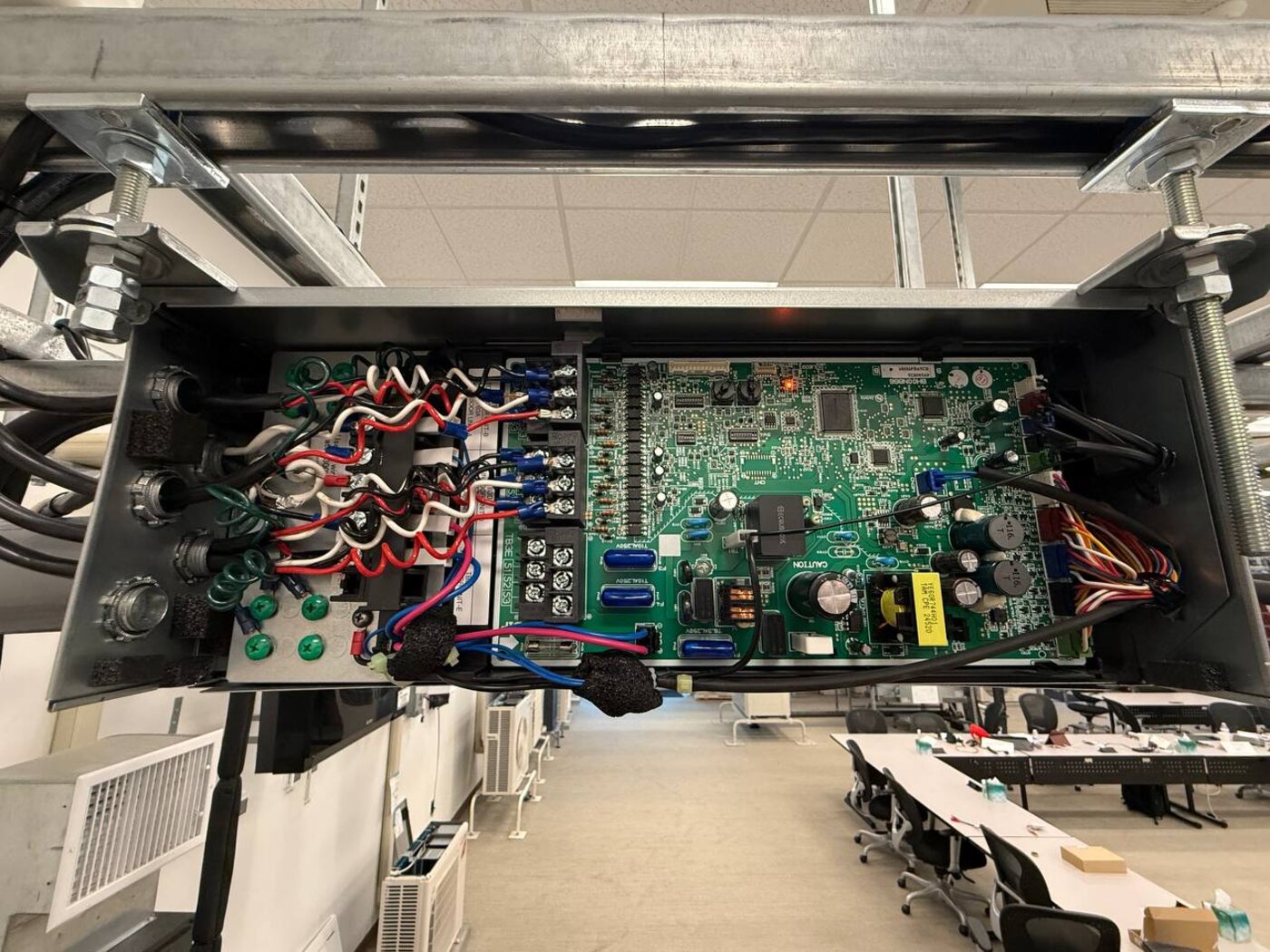
Mitsubishi systems run constant self-checks. When the unit’s control board sees a reading it doesn’t like, it logs a fault and flashes the indicator light in a specific rhythm. So many blinks, a pause, then it repeats. Some models also show a code on the wireless remote or on a small display.
That rhythm maps to a particular fault. The catch is that the patterns and the code numbers differ between the M-Series single-zone units, MXZ multi-zone setups, and the P-Series. The same blink count on two different models can mean two different things. That’s why we don’t publish a “your code means this” chart. We read the actual code on your equipment against the right service documentation, then confirm it with measurements before we name a part. Guessing a code off the internet is how people end up buying the wrong board.
What’s usually behind a fault light
We won’t invent a number for your situation, but in general terms, most Mitsubishi fault lights trace back to a handful of areas.
Sensor or thermistor faults. Mini-splits rely on small temperature sensors (thermistors) scattered through the indoor and outdoor units. They read coil temperature, room temperature, and refrigerant pipe temperature. If one drifts out of range, reads open, or shorts, the board flags it. These are common, and on the diagnostic side they’re usually straightforward to test.
Indoor-to-outdoor communication errors. Your indoor head and the outdoor unit are always talking over the control wiring. If that conversation drops, because of a loose connection, a damaged wire, a voltage problem, or a fault in either board, the system throws a communication code. This one is common on systems that have been in service a while or had rodent or weather damage to the line set wiring.
Condensate and drain issues. When your mini-split is cooling, it pulls water out of the air, and that water has to drain. If the condensate pan fills up or the drain clogs, many units will fault and shut down on purpose so they don’t overflow and dump water into your wall. The Bay Area’s mix of dust and our cooling season makes drain clogs a regular offender.
There are other possibilities (refrigerant problems, fan motor faults, defrost behavior on Hyper-Heat H2i cold-climate units), but those need testing to confirm.
Safe checks you can do first
Before you call anyone, there are three things you can check yourself without tools and without opening anything sealed.
1. Clean or check the filters. Pop open the front of the indoor head and pull the filters. If they’re loaded with dust, a restricted filter can choke airflow and trip a fault. Rinse them, let them dry fully, and put them back. This is the single most common thing homeowners overlook.
2. Check the power. Go to your electrical panel and confirm the breaker for the system hasn’t tripped or isn’t sitting halfway. Flip it fully off, wait a couple of minutes, then back on. That clears some brief faults. If the breaker trips again right away, stop and leave it off. That’s an electrical issue, not a reset job.
3. Look at the drain. If you can see the condensate drain line outside or under the unit, check that nothing’s blocking it and water can get out. Standing water or a musty smell near the indoor head points at a drain problem.
If one of those clears the light, great. If the light comes right back, the reset only hid the symptom.
When to call us
Call when the light keeps coming back after a reset, when the breaker won’t stay on, when the unit won’t heat or cool, or when you’ve done the homeowner checks and it’s still flashing. Anything involving refrigerant, the control boards, the sensors, or the wiring needs meters and the wiring diagram, not guesswork.
We’re factory-trained on Mitsubishi M- and P-Series. Andrew completed Mitsubishi Electric’s M- and P-Series Essentials course in May 2026 and the Advanced M- and P-Series Service course at the Mitsubishi Electric Los Angeles factory training center in June 2026. So when we read your blink code, we’re reading it against real Mitsubishi training, not a general HVAC background.
Our diagnostic is $99, and we credit it toward the repair if you go ahead with us. You get a written estimate before any work starts. And if it turns out the system is past its useful life and a new install makes more sense, our new HVAC installs carry a 10-year parts warranty plus a labor warranty (2 years standard, extended to 10 years with our maintenance plan).
Bay Area HVAC Service is the HVAC division of ADRIUM Service Solutions, based in San Ramon (CSLB #1136642, EPA 608). If your Mitsubishi mini-split is blinking at you and the basic checks didn’t fix it, give us a call and we’ll read what it’s actually saying.
One more culprit worth checking before you call: a frozen indoor coil will trip fault codes on many Mitsubishi units. If you see ice on the coil or water where it should not be, our frozen AC coils guide covers what to do right now and why it keeps coming back.
Key takeaways
- A blinking light on a Mitsubishi indoor head is a fault code. The pattern of blinks and pauses points a trained tech to the part of the system that is unhappy.
- You can safely check three things first: a dirty filter, the power supply at the breaker, and a clogged condensate drain. Sometimes that clears it.
- Common general causes are sensor (thermistor) faults, indoor-to-outdoor communication errors, and condensate or drain problems.
- If a basic reset and the homeowner checks don't fix it, stop guessing. Reading the exact code and testing the system takes meters and the wiring diagram.
Related questions
Can I just reset my Mitsubishi mini-split to clear the blinking light?
Is it safe to keep running the system while the light is blinking?
Why won't you tell me my exact error code online?
How much does a Mitsubishi mini-split diagnostic cost?
Are you Mitsubishi trained?
Need help with your system? Call (925) 999-4095 or book a visit. Repair diagnostics are $99, credited toward the repair. Installation assessments are free.
Further reading
Need HVAC help in the Bay Area?
We serve 56 cities. Same or next day when we can.
Bay Area · 7am–7pm · 7 days · no overtime charges