
What Size Heat Pump Do You Need for a Bay Area Home?
The single most common heat-pump install mistake we see in the Bay Area: oversizing. The customer assumes that because heat pumps “lose capacity in cold weather,” they should buy extra. So a home that genuinely needs a 3-ton heat pump gets a 4 or 4.5-ton install. Then the homeowner spends years wondering why the new system is louder than they expected, why humidity feels wrong, and why utility bills didn’t drop the way the sales pitch promised.
This guide walks through how heat-pump sizing actually works in our climate, what cold-weather performance looks like on 2026 equipment, and what realistic tonnage looks like for typical homes across our service area. If you want to skip the theory, our free HVAC load calculator gives you a heat-pump-aware sizing estimate in under five minutes.
Heat pumps have to meet two loads, not one
A straight AC has one job: handle the cooling load on the hottest design day. A heat pump has two: handle cooling AND handle heating.
In most US climates, those two loads point in different directions. A Minneapolis home has a moderate cooling load and a brutal heating load. A Phoenix home has the opposite. A correctly sized heat pump there has to balance both.
The Bay Area is unusual: our heating load is almost always smaller than our cooling load. Design cooling temperatures range from 81°F (East Bay coast, CZ3) to 99°F (Tri-Valley inland, CZ12). Design heating ranges from 30°F (CZ12) to 36°F (CZ3). The cooling-to-heating spread in BTU/h is wide enough that cooling almost always wins as the sizing driver.
Translation: when sizing a Bay Area heat pump, calculate the cooling load first. If the heating load is smaller (it usually is), the cooling number is your answer. If the heating load is somehow larger, possible for unusually leaky homes or homes with very large second stories in CZ12, the heating number takes over.
Cold-weather performance: what’s actually true in 2026
The folk wisdom “heat pumps don’t work when it’s cold” was true around 1995. It is not true now.
Modern variable-speed cold-climate heat pumps maintain rated heating capacity well below freezing. The leaders in the Bay Area market:
- Daikin Aurora: full rated capacity to 5°F, partial capacity to -13°F.
- Mitsubishi Hyper-Heat: full rated capacity to 5°F, partial capacity to -13°F.
- Cooper & Hunter PEAQ: full rated capacity to 5°F.
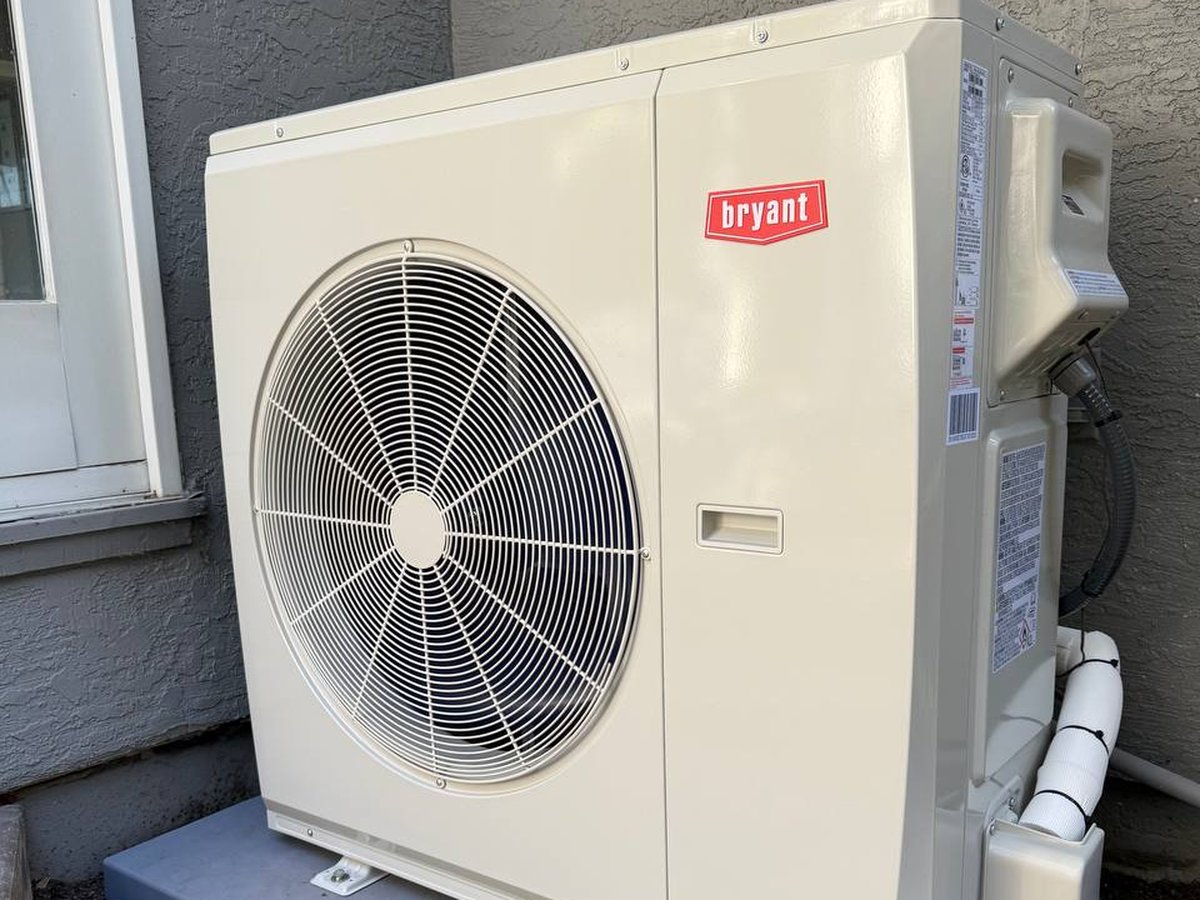
- Bryant Evolution 291VAN: 100% rated capacity to 5°F.
The Bay Area’s coldest design temperature is 30°F (CZ12). Every model above operates well within its rated range at our design heating temperature. The “heat pump needs backup strips” assumption was a 1990s northern-climate concern that does not apply to most Bay Area homes.
Balance point: the math nobody calculates and almost nobody needs
Balance point is the outdoor temperature at which the heat pump’s actual capacity equals the building’s heating load. Above balance point, the heat pump heats the house alone. Below balance point, supplemental heat is required.
For a typical Tri-Valley CZ12 home with a 30,000 BTU/h design heating load at 30°F, paired with a 3-ton modern heat pump rated at 36,000 BTU/h at 47°F:
- At 47°F outdoor, capacity is 36,000 BTU/h. The home needs maybe 15,000 BTU/h. Balance is comfortable.
- At 30°F outdoor (design), modern equipment delivers ~32,000 BTU/h. The home needs 30,000 BTU/h. Still balanced, no backup heat called.
- At 15°F outdoor (extreme cold event, happens almost never in CZ12), capacity drops to ~25,000 BTU/h. The home would need ~38,000 BTU/h. Backup heat would help, for the few hours per decade this matters.
For East Bay coast (CZ3) and South Bay (CZ4), balance point math is even more favorable. In practice, we install Bay Area heat pumps without electric backup strips for typical residential applications. The few exceptions are oversized homes with high heating loads in the coldest CZ12 microclimates.
Variable-speed sizing rules: why oversizing hurts more than helps
A variable-speed inverter heat pump modulates capacity continuously between about 30% and 100% of rated. That’s the source of its efficiency advantage, it can match a partial load by running slowly and efficiently rather than blasting full-speed then shutting off.
But this only works if the equipment is correctly sized.
A 3-ton variable-speed heat pump installed in a home that needs 3 tons at design conditions runs at:
- 30-50% capacity most of the time (quiet, efficient sweet spot)
- 60-80% on a typical summer afternoon
- 90-100% only on the hottest design day
A 4-ton variable-speed heat pump in the same home runs at:
- Minimum 30% capacity is already 1.2 tons, more than the house needs except on hot days
- The system short-cycles even at minimum modulation
- You paid extra for variable-speed efficiency and you get none of it
Bigger ≠ better with variable-speed equipment. Correctly sized is exactly the right answer.
Typical heat-pump sizing by region
Use these as starting points. Real sizing requires Manual J inputs for your specific home, our free load calculator walks through them.
Tri-Valley / Diablo Valley (CZ12): cooling-dominant climate. San Ramon, Danville, Pleasanton, Walnut Creek:
- 1,200-1,800 sqft → 2-3 tons
- 1,800-2,500 sqft → 3-4 tons
- 2,500-3,500 sqft two-story → 3.5-5 tons (often dual-zone)
South Bay (CZ4): moderate cooling, mild heating. Fremont, Newark, Union City:
- 1,200-1,800 sqft → 2-2.5 tons
- 1,800-2,500 sqft → 2.5-3.5 tons
- 2,500-3,500 sqft → 3-4 tons
East Bay coast (CZ3): light cooling, mild heating. Oakland, Berkeley, Richmond:
- 1,500-2,500 sqft → 1.5-2.5 tons OR ductless mini-split per zone
- 2,500-3,500 sqft → 2-3 tons (often hybrid with mini-split second story)
What about a ducted vs ductless heat pump?
If your home already has working ductwork, ducted heat pump is usually the cleaner answer, same registers, same return, the swap fits where the old furnace and condenser were. We pair the ducted condenser with an air handler that bolts to the existing duct system.
If your home has no ductwork (common in older Berkeley/Oakland flats, or ADUs and additions), ductless mini-split is almost always the right answer. Each zone gets its own indoor head, no walls torn up to run ducts, capacity matched per room.
A few homes do both: ducted main system for the first floor where ducts already exist, plus a single ductless head for an upstairs that the original ducts never served well. We size each component independently.
What this means for your install estimate
When you call us for a heat pump quote, the sizing math comes before the equipment recommendation, not after. We measure the envelope, count windows, look at the ducts, run the Manual J. The tonnage number that comes out determines which models we recommend, not the other way around.
Pricing for a typical install runs $14,000-$15,500 for a 4-ton system in CZ12, before rebates. Full breakdown: What Heat Pump Installation Actually Costs.
Ready for the real numbers on your home? Use the free HVAC load calculator for an instant ballpark, or call (925) 999-4095 and we’ll schedule an on-site Manual J.
Related reading:
- HVAC Sizing Guide: AC Tonnage for Bay Area Homes
- AC Sizing Rules of Thumb (And Why They’re Wrong)
- Heat Pump or Gas Furnace in the Bay Area
- Heat Pump vs Mini-Split
Key takeaways
- Bay Area heat-pump sizing is governed by cooling load, not heating, design cooling temperatures dwarf design heating in our climate.
- Modern cold-climate heat pumps maintain rated capacity well below freezing; the old 'heat pumps don't work in cold weather' objection does not apply to 2026 equipment.
- Balance point, the temperature at which heat pump capacity equals heating load, is rarely a problem in the Bay Area, even for CZ12 inland homes.
- Variable-speed inverter heat pumps modulate from ~30% to 100% capacity; oversizing forces them out of their efficient range.
- Typical sizing: 2-3 tons for a 1,500-2,000 sqft Tri-Valley home, 3-4 tons for 2,000-2,800 sqft, 4-5 tons for 2,800-3,500 sqft.
- Use our [free load calculator](/free-hvac-load-calculator/) for a heat-pump sizing estimate in under five minutes.
Related questions
Do Bay Area heat pumps need to be sized differently than ACs?
What is balance point and does it matter in the Bay Area?
Should I oversize my heat pump for cold mornings?
How is heat-pump capacity rated and how does that match my Manual J number?
What about heat-pump water heaters? Do those affect sizing?
Need help with your system? Call (925) 999-4095 or book a visit. Repair diagnostics are $99, credited toward the repair. Installation assessments are free.
Further reading
Need HVAC help in the Bay Area?
We serve 56 cities. Same or next day when we can.
Bay Area · 7am–7pm · 7 days · no overtime charges