
HVAC Sizing Guide: Right AC Tonnage for Your Bay Area Home
Two-thirds of the HVAC replacement quotes we audit in the Bay Area are sized wrong. The dominant mistake isn’t undersizing: it’s oversizing. A 30-year-old 4-ton system gets replaced with another 4-ton system because “we have a 4-ton now,” when the home actually needs 2.5 or 3 tons. The customer pays for extra equipment, then pays again in utility bills, then pays a third time when the compressor wears out from short-cycling far earlier than it should.
This guide explains how HVAC sizing actually works, why the Bay Area is harder to size than most US regions, and what realistic tonnage looks like for typical homes in San Ramon, Oakland, San Jose, and our other service cities. If you just want a number for your specific home, our free HVAC load calculator gives you a ballpark in under five minutes.
What Manual J actually does
Manual J is the residential load calculation standard published by the Air Conditioning Contractors of America. Every California HVAC installation permit requires one on file. Manual J calculates two numbers:
- Cooling load in BTU/h, which converts to tons (1 ton = 12,000 BTU/h)
- Heating load in BTU/h, which determines furnace input or heat pump capacity
To produce those numbers it asks for: floor area by zone, ceiling height, window-to-wall ratio and orientation, insulation levels in walls/attic/floor, air-leakage rate, duct location and condition, occupancy, internal heat gain (lights, appliances, pets), and design temperatures specific to your climate zone.
Then it solves the heat-flow equations and outputs the load. Done right, it takes 30-45 minutes for a typical single-family home.
What it does NOT do: take “we have a 3-ton now” as input.
Why the Bay Area is uniquely hard to size
Most US metros sit in one climate zone. Phoenix is hot. Minneapolis is cold. The Bay Area covers three California Energy Commission zones:
-
CZ3: East Bay Coast and SF Peninsula. Oakland, Berkeley, Alameda, El Cerrito, Richmond, parts of Hayward, the SF Peninsula coast. Design cooling ~81°F along the immediate coast (per CEC climate-zone tables). The inland edge of the same zone, Union City, Fremont: runs warmer at ~86–88°F. Design heating ~36°F throughout. Many coastal CZ3 homes don’t even have AC. When they do, sizing is light: 1.5-2.5 tons for a 1,500-2,500 sqft home is typical.
-
CZ4: South Bay. San Jose, Fremont, Newark, Union City, Milpitas. Design cooling ~92°F. Design heating ~35°F. AC is meaningful in summer. Typical sizing: 2-4 tons for 1,500-2,800 sqft.
-
CZ12: Tri-Valley and Diablo Valley. San Ramon, Danville, Alamo, Blackhawk, Dublin, Pleasanton, Livermore, Walnut Creek, Lafayette, Moraga, Orinda, Concord, Martinez. Design cooling ~99°F. Design heating ~30°F. Both cooling and heating matter, cooling drives equipment selection. Typical sizing: 3-5 tons for 2,000-3,500 sqft.
This is why two homes the same size on opposite sides of the Caldecott Tunnel end up with completely different equipment. Sizing without knowing the climate zone is sizing blind.
The inputs that move the number most
In rough order of impact for typical Bay Area homes:
- Climate zone. CZ3 vs CZ12 alone can mean 1.5 tons difference for the same floor plan.
- Window area and orientation. Big west-facing windows in CZ12 add a ton of afternoon cooling load that east-facing windows of the same size do not.
- Insulation level (envelope vintage). A 1965 home with original R-11 walls and R-19 attic loses heat 60% faster than the same home re-insulated to current code.
- Air leakage. Drafty homes pull in unconditioned outside air; leakage can add 20-40% to design loads.
- Duct location and condition. Ducts in an unconditioned attic in CZ12 lose 15-30% of their heat in summer. Manual J typically prices this in via a duct loss factor.
- Occupancy and internal gain. Each person adds 230 BTU/h sensible + latent. Each modern fridge contributes ~150 BTU/h continuous.
- Floor area. Yes, square footage matters, but it’s #7 on the list, not #1.
Note what’s NOT on the list: existing equipment size. Manual J does not care what tonnage you have today.
Why oversizing hurts (more than undersizing in our climate)
Oversized HVAC equipment short-cycles. Here’s what that costs you:
- Humidity stays high. An AC removes moisture by running. Short cycles never run long enough. You get cool but clammy rooms.
- Compressor wears out. Every start is the highest-load event in the equipment’s life. Twice as many starts roughly halves equipment life.
- Utility bills go up. Oversizing defeats the variable-speed efficiency you paid for on modern heat pumps and inverter ACs. The big jump-then-stop cycle never lets the system enter its efficient modulation range.
- Hot and cold spots multiply. Big bursts of cold air collapse to the floor while the second story still bakes. Ductwork can’t keep up with the instantaneous capacity.
Undersizing has the opposite failure mode: system runs constantly on the hottest day and never quite catches up. In Bay Area CZ12, that happens maybe 5-10 days per year. Most homes can live with slight undersizing far better than significant oversizing.
Realistic tonnage ranges by city
These are starting points only, climate, envelope, and ducting still drive the final number. Use the load calculator for your specific home.
Tri-Valley / Diablo Valley (CZ12): homes typically need cooling, sometimes hard. San Ramon, Danville, Walnut Creek, Pleasanton:
- 1,200-1,800 sqft single-story → 2-3 tons
- 1,800-2,500 sqft → 3-4 tons
- 2,500-3,500 sqft two-story → 3.5-5 tons (often dual-zone)
- 3,500+ sqft → 4-6 tons, almost always dual-zone
South Bay (CZ4): moderate cooling needs. Fremont, Newark, Union City, Milpitas:
- 1,200-1,800 sqft → 2-2.5 tons
- 1,800-2,500 sqft → 2.5-3.5 tons
- 2,500-3,500 sqft → 3-4.5 tons
East Bay Coast (CZ3): many homes can get away with mini-split per-room rather than central. Oakland, Berkeley, Richmond:
- 1,200-1,800 sqft → 1.5-2 tons or 2-3 mini-split heads
- 1,800-2,500 sqft → 2-2.5 tons or ductless mini-split
- 2,500-3,500 sqft → 2.5-3.5 tons (often spilled into mini-split for second story)
Worked example: sizing a real 2,200 sqft Union City home
Here’s how Manual J math worked on a recent job. The numbers are real, the methodology is the same Manual J we use on every quote.
House profile: 2,200 sqft single-story ranch in Union City, built 1978, R-19 attic insulation, R-13 walls, dual-pane retrofit windows, average solar exposure. Climate zone 3 inland sub-region (Union City and Fremont sit at the warmer edge of CZ3, distinct from the coastal sub-region in Oakland and the Peninsula), design cooling 88°F, design heating 38°F.
Step 1, envelope load:
- Walls: 1,400 sqft @ U-0.08 × (88 − 75) = 1,456 BTU/h
- Ceiling: 2,200 sqft @ U-0.05 × 13 = 1,430 BTU/h
- Windows: 280 sqft @ U-0.35 × 13 + solar gain 8,500 = 9,774 BTU/h
- Floor (uninsulated crawl): 2,200 sqft @ U-0.10 × 13 = 2,860 BTU/h
- Infiltration (0.5 ACH × 17,600 cu ft × 1.08 × 13) = 12,355 BTU/h
Step 2, internal gains: 4 occupants × 230 BTU/h = 920; appliances 1,200; lighting 600 = 2,720 BTU/h
Step 3, total cooling load: 1,456 + 1,430 + 9,774 + 2,860 + 12,355 + 2,720 = 30,595 BTU/h
Step 4, tonnage: 30,595 ÷ 12,000 = 2.55 tons → round to 2.5 tons
The homeowner had been quoted 4 tons by two prior contractors. We installed a 2.5-ton Goodman variable-speed heat pump. After install, runtime data showed the system running well within capacity on peak summer days, consistent with what Manual J predicted. A 4-ton unit would have short-cycled all summer, killed humidity control, and significantly shortened compressor life.
The rule of thumb said 4 tons. Manual J said 2.5. Reality confirmed 2.5. That’s the difference and that’s why we do the math.
Want to try the same calculation on your home? Use the free HVAC load calculator, it runs Manual J Lite with the same envelope, climate-zone, and infiltration inputs.
How heat-pump sizing differs from straight-AC sizing
A heat pump installation has to meet both the cooling load AND the heating load. In Bay Area CZ12, where design heating is around 30°F and design cooling near 100°F, the cooling load almost always governs. The 3.5-ton heat pump sized for your CZ12 summer is more than enough for the coldest morning in February.
Modern cold-climate equipment matters here. Daikin Aurora, Mitsubishi Hyper-Heat, and Cooper & Hunter PEAQ deliver full rated capacity well below freezing. The old objection “heat pumps don’t work in cold weather” referenced 1990s equipment and doesn’t apply to 2026 installs.
For more on heat-pump-vs-furnace economics in the Bay Area, read Heat Pump or Gas Furnace in the Bay Area and What Heat Pump Installation Actually Costs.
What to do next
Use the free HVAC load calculator for an instant ballpark. It uses Title 24 envelope defaults by vintage, climate-zone-specific design temperatures, and the same Manual J logic we walk through on a real estimate.
When you’re ready for binding numbers, we come out and measure for real. That’s included with every install estimate. And if your existing system is on its last legs, AC repair or furnace repair can sometimes buy a year or two while you plan the right replacement.
Call us at (925) 999-4095 or browse our service pages when you’re ready.
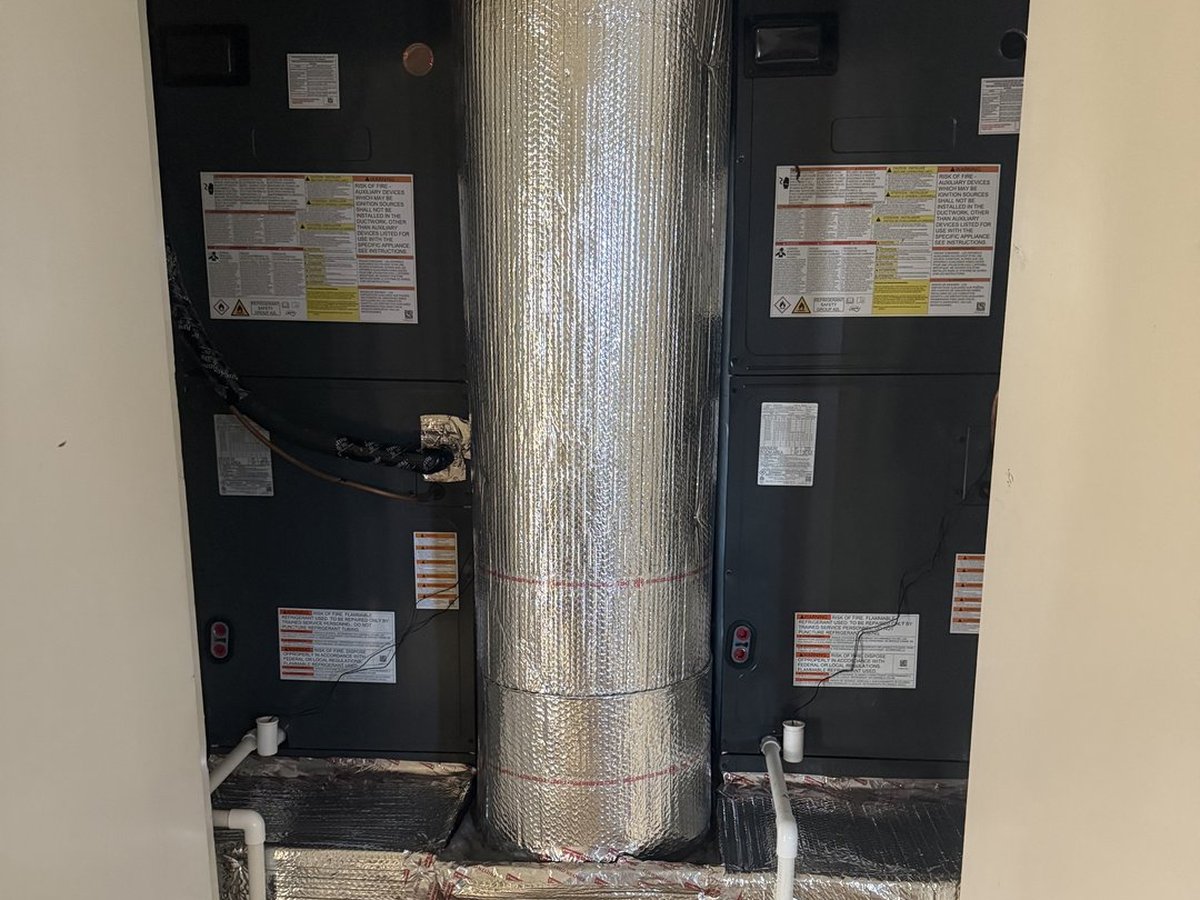
A Package-Unit Install, On Camera
Key takeaways
- Manual J is the industry-standard sizing method required by every California HVAC permit; rule-of-thumb sizing is wrong about two-thirds of the time.
- Bay Area spans three California Energy Commission climate zones with design temperatures from 81°F (East Bay coast) to 99°F (Tri-Valley).
- Oversizing is far more common than undersizing in our service area and causes short-cycling, humidity problems, and shortened equipment life.
- Typical homes: CZ3 coast 1.5–2.5 tons for 1,500–2,500 sqft; CZ4 South Bay 2–4 tons; CZ12 inland 3–5 tons.
- Heat-pump sizing differs from straight-AC sizing, cold-weather capacity matters, balance points need to be considered.
- Try our [free load calculator](/free-hvac-load-calculator/) for an instant ballpark within ±0.5 tons of a full Manual J.
Related questions
Can I just use my existing HVAC tonnage when I replace?
What's the rule of thumb for HVAC sizing, 1 ton per 500 sqft?
Why does climate zone matter so much for Bay Area sizing?
How accurate is your free calculator vs a real Manual J?
Does heat pump sizing work differently from AC sizing?
Need help with your system? Call (925) 999-4095 or book a visit. Repair diagnostics are $99, credited toward the repair. Installation assessments are free.
Further reading
Need HVAC help in the Bay Area?
We serve 56 cities. Same or next day when we can.
Bay Area · 7am–7pm · 7 days · no overtime charges