
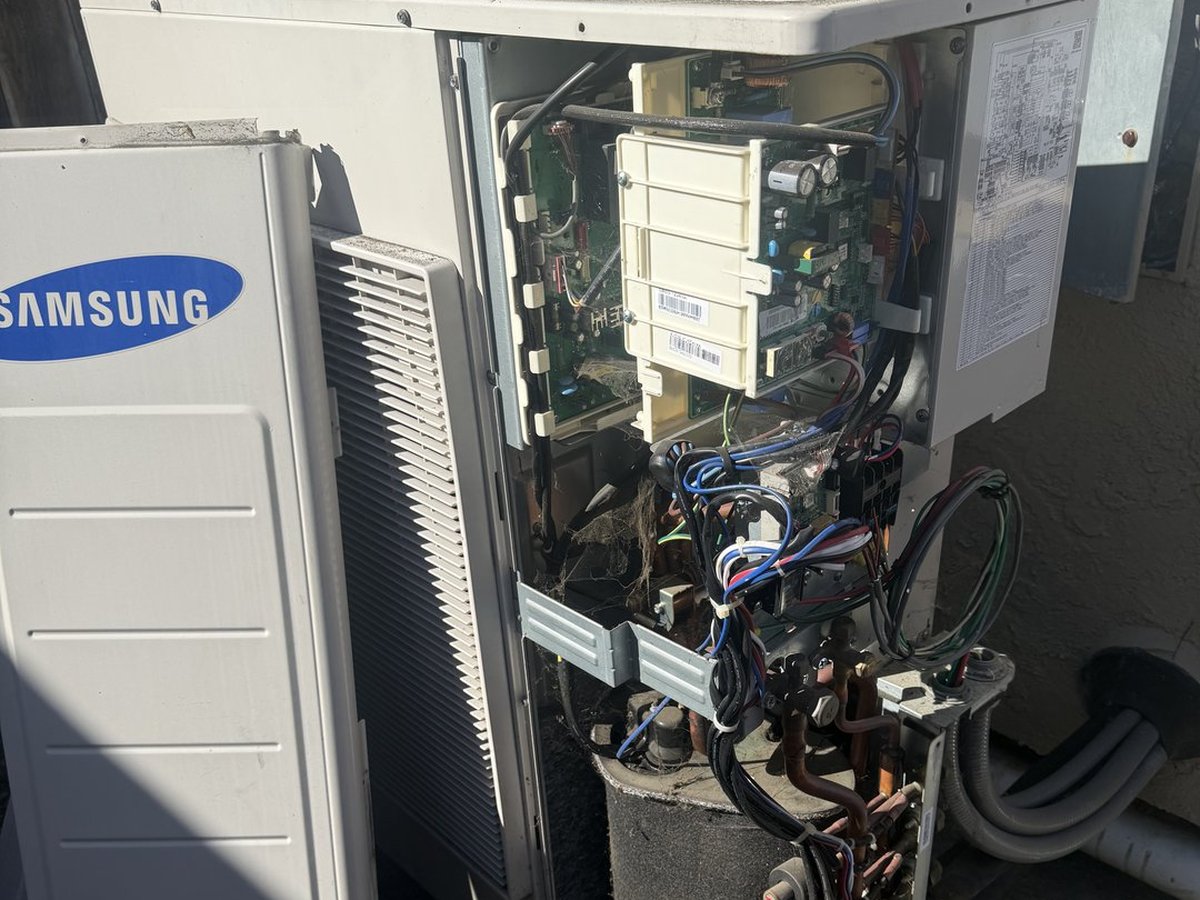
When customers call about a heat pump install, the first question we run through is: do you have working ductwork? That single answer drives the recommendation more than anything else.
Same equipment, different delivery
Both ducted heat pumps and ductless mini-splits are heat pumps. They use the same refrigeration cycle and the same physics. The difference is how the conditioned air gets from the indoor coil to the rooms in your house.
Ducted heat pump:
- One indoor air handler (usually in attic, closet, or garage)
- Refrigerant line set runs from outdoor condenser to indoor air handler
- Conditioned air flows through ductwork to registers in each room
- One outdoor unit, one indoor unit, multiple rooms served
Ductless mini-split:
- One outdoor condenser (or several, on larger systems)
- Multiple smaller indoor heads, one per zone
- Refrigerant line sets run from outdoor unit directly to each indoor head
- Each head has its own remote and thermostat (or unified app control)
The efficiency rating math is similar (modern equipment runs 15 to 22 SEER2 on both sides). The decision is structural.
When ducted heat pump wins
Three conditions push toward ducted:
- Your existing ductwork is in usable condition. Leakage under 15 percent on a duct test, no major damage, R-6 or better insulation on attic runs. Most Bay Area tract homes built since 1985 fall here.
- You want one thermostat to control the whole house. Ducted is the simpler interface for that.
- You don’t need zone-by-zone control. If your family is fine with the same temperature in every room, ducted is the cheaper-per-room answer.
For most San Ramon, Pleasanton, Dublin, Concord tract homes built between 1985 and 2010, ducted heat pump replacement is the cleanest answer.
When ductless mini-split wins
Ductless is the answer when one of these is true:
- No existing ductwork. Common in pre-1950 Bay Area homes, Berkeley Craftsmans, Oakland bungalows, Alameda Victorians, the older Lafayette and Orinda mid-centuries. Adding central ducting means cutting into walls, ceilings, and finished plaster; the construction often costs as much as the HVAC equipment and disrupts the home for weeks.
- Existing ductwork is failing. If your ducts are 30+ years old with collapsed sections, asbestos insulation that requires abatement, or leakage above 25 percent that can’t be sealed effectively, replacement adds $4,000 to $10,000 to a ducted system price. Sometimes ductless costs less when ducts are this far gone.
- You want zoned temperature control. Bedrooms cooler at night while the living room stays warm in the morning. Home office at one setting while the rest of the house holds another. Each indoor head is independent.
Ductless also fits additions and bonus rooms that don’t connect to the main duct system. A single-zone ductless in a converted garage or attic room is usually cheaper than extending ductwork to a new space.
The “in-between” cases
Two situations don’t resolve on ductwork alone.
Some homes have ducts to the main floor, but the second story was never ducted and the bedrooms get baseboard or wall heaters instead. We sometimes install a hybrid there: ducted heat pump for the main floor, plus 2 to 3 ductless heads upstairs. Best of both, more complex to spec.
Aging ducts in a house that’s about to be remodeled are the other one. If you’re planning a kitchen or bath remodel in the next 1 to 3 years, that work may give us cheap access to the ducts while the walls are already open. Ducted heat pump now, with duct sealing planned into the remodel, often wins. We talk timing through at the estimate.
What about cost?
Per-zone, ductless costs more upfront: multi-zone ductless rarely beats ducted on a per-square-foot basis when you already have working ducts. But the comparison shifts when:
- Ductwork is failing and needs replacement ($4,000 to $10,000 add)
- The home has no ductwork (ducted is not really an option)
- You value per-room control
We run both numbers at the estimate when both options are on the table. Most customers with working ductwork end up with ducted; homes without ducts almost always go ductless; hybrid setups are the least common.
Rebates apply to both
BayREN, MCE Heat Pump HVAC, PG&E rebates, EBCE/Ava (Alameda County), and manufacturer instant rebates apply to both ducted heat pumps and ductless mini-splits. Eligibility is based on equipment efficiency rating and whether the contractor is registered with the program. We confirm what programs are currently paying and whether we qualify when we write your estimate.
Brands we install
For ductless: Daikin and Mitsubishi are the most reliable choices. Both have factory-trained installer programs (we completed Daikin factory training in Houston in 2025), good parts availability, and 10-year manufacturer parts warranties. LG, Cooper & Hunter, and Gree are workable second-tier options.
For ducted: Carrier, Daikin/Goodman, Trane, Lennox, and Mitsubishi all make solid variable-speed ducted heat pumps. We don’t push any single brand; we recommend what fits the home, budget, and parts-availability practical realities.
Related reading
- Heat pump installation cost in the Bay Area in 2026
- Heat pump or gas furnace, 2026 decision guide
- California heat pump rebates 2026, what’s actually funded
Key takeaways
- If you have working ductwork: ducted heat pump is usually the right answer.
- If you have no ducts (1920s-50s Craftsmans, Victorians): ductless mini-split is almost always cleaner.
- If your ducts are 25+ years old and in poor condition: consider ductless before pouring money into duct replacement.
- Multi-zone ductless is best for additions, bonus rooms, and zoned comfort needs.
- Both qualify for the same rebate programs (BayREN, MCE, PG&E, EBCE, manufacturer).
Related questions
Aren't they both heat pumps?
If I have ducts, which is better?
What about homes with no ductwork?
How many heads do I need on a multi-zone?
What about cost?
Need help with your system? Call (925) 999-4095 or book a visit. Repair diagnostics are $99, credited toward the repair. Installation assessments are free.
Further reading
Need HVAC help in the Bay Area?
We serve 56 cities. Same or next day when we can.
Bay Area · 7am–7pm · 7 days · no overtime charges