
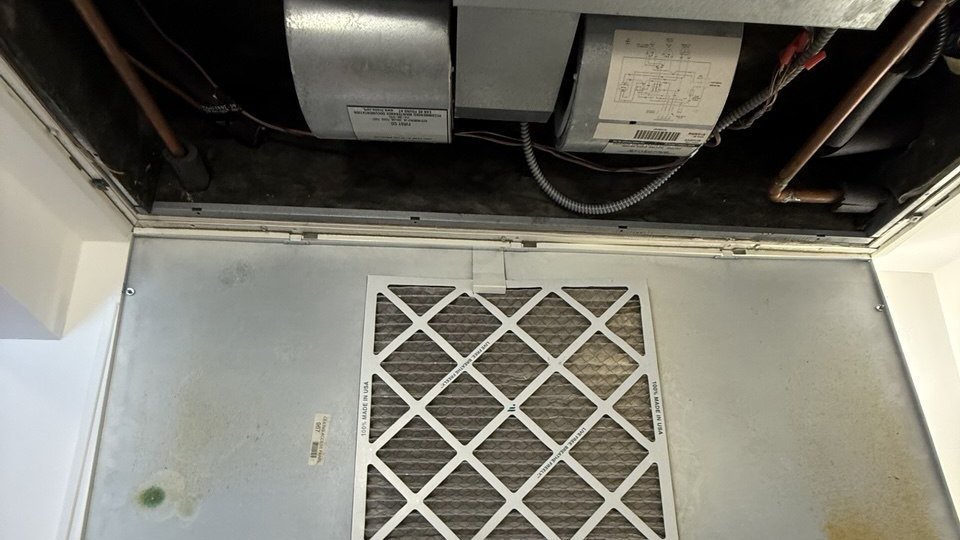
A whistling air conditioner is almost always air, not refrigerant. The blower is pulling air through a gap or a restriction faster than that opening was made for, and the air sings on the way through. Most often the source is on the return side: a loaded filter, a return grille that can’t breathe, or a return duct that’s too small or has pulled apart at a joint.
Hiss and squeal are different problems with different urgency.
Whistle, Hiss, or Squeal: Sort the Sound First
Whistle. A steady tone that starts when the indoor blower starts and stops when it stops. The pitch tracks blower speed. It often gets louder when you close an interior door and quieter, or gone, when you open the filter door for a moment. That’s air noise, and the fix is on the airflow side.
Hiss. A softer, continuous sound like a slow leak from a tire, sometimes with a gurgle or bubble in it. It can keep going after the blower shuts off, and it comes from the coil cabinet, the copper lines, or the outdoor unit rather than a grille. A hiss that lasts is a refrigerant question, and refrigerant is not a homeowner job. One exception: a few seconds of hiss or a soft whoosh right at shutdown is normal pressure equalizing in the refrigerant circuit, and a heat pump adds a whoosh when the reversing valve shifts. If it fades in seconds and doesn’t come back, ignore it.
Squeal or screech. Harsh, high-pitched, and mechanical. It’s worst at startup and changes as the motor comes up to speed. Doors and filters make no difference to it. Indoors that’s a blower motor bearing drying out or, on older belt-drive air handlers, a worn belt. At the outdoor unit it’s the condenser fan motor. Either way, a motor on its way out.
If you’re not sure which you’re hearing, note where it’s loudest and whether it runs with the blower or outlasts it. Those two details settle most of it.
Why an AC Whistles: The Return Side Can’t Keep Up
The blower moves a fixed volume of air. The return ducts and the filter have to supply that much air, and when they can’t, the blower pulls harder against the restriction. Air speeds up through whatever opening is left, and fast air through a narrow gap whistles.
The filter
The most common cause and the easiest fix. A filter loaded with dust chokes the return, and a filter denser than the return was sized for does the same thing brand new. A whistle that started right after a filter change deserves a second look at the rating, and at the fit, because air whistles through the gap around a filter that’s the wrong size.
Closed or blocked supply registers
Closing registers in unused rooms feels like it should push more air where you want it. What it actually does is raise pressure in the supply side, and the system pushes back through every seam it has. That shows up as whistling at the open registers and at duct joints you can’t see. Furniture over a register does the same thing, and so do rugs and drapes.
An undersized or leaking return duct
Older homes often have one return sized for the original equipment, not for a newer, higher-capacity blower. When the return is starved you get a whistle at the grille and a filter sucked into a bow. The return door gets hard to open, too. A return duct that has pulled apart at a joint in the attic or crawl space adds its own whistle as it draws in dusty, unconditioned air. Our post on signs your air ducts are leaking covers what that costs you beyond the noise.
A supply duct leak near a joint
On the supply side, a whistle usually means air escaping under pressure through a seam: a collar that’s worked loose from the plenum, or a flex duct connection where the tape let go. A takeoff that was never sealed does the same. You’ll often hear it from the attic or a closet rather than at a register, and the room on that run never cools right.
A stuck damper
Zoned systems have motorized dampers in the ductwork, and many branch runs have manual ones. Either kind stuck partway closed turns a duct into a whistle. On a zoned house the tell is that the sound comes and goes with the zone calls.
What a Tech Actually Checks
We don’t diagnose a whistle by ear. We measure static pressure across the filter and the indoor coil, which says whether the return is starved, the coil is dirty, or the ducts are undersized. We check blower amp draw, because a motor fighting a restriction pulls more current than it should and wears faster. On a hiss call we put gauges on the system and leak-search the lines and the coil.
What You Can Safely Check
Before you call, these are fair game:
- Filter. Pull it and look. If it’s gray, replace it with the size and rating shown for your installation, arrow toward the blower. If the whistle stops, you’re done. If not, you’ve ruled out the cheap fix.
- Supply registers. Walk every room and open every register all the way. Move whatever is sitting on or in front of them.
- Return grille. Make sure nothing is stacked against it, the filter door is closed and latched, and the grille itself is screwed down. A loose grille buzzes; a gap around a filter door whistles.
- Visible duct joints. From the attic hatch or the crawl space entry, look for a connection that’s pulled apart, peeled tape, or a crushed flex duct. Note where it is. Don’t tape it back yourself; a joint that let go once will let go again until someone finds out why.
- Outdoor unit clearance. From outside the cabinet, check for leaves, plants, or storage crowding the sides. A true whistle out there is unusual; more often it’s debris against the fan grille. Our outdoor unit clearance checklist covers what to look at without touching anything.
Write down what changed. If a new filter killed the whistle, or you found a closed register or a joint that had pulled apart, that note saves diagnostic time when we arrive.
What Not to Touch
Refrigerant lines, the capacitor, the wiring, and the blower compartment. That’s the whole list, and it’s firm.
Refrigerant handling is EPA Section 608 work (we hold the Universal certification), and a hiss doesn’t tell you where the leak is or how much charge is left. Adding refrigerant on top of a leak buys a few weeks and can overcharge the system on the way. The capacitor in the outdoor unit holds a charge after the power is off and can hurt you. The disconnect, the contactor, and the control board are live circuits.
That’s not us being protective of the work. A wrong guess here gets expensive or dangerous, and a repair done by a licensed tech carries a warranty that a homeowner repair doesn’t.
When to Book a Diagnostic
Book it if the whistle survives a fresh filter and open registers, if you hear a hiss that outlasts the shutdown, if there’s a squeal from either the air handler or the outdoor unit, or if the noise comes with weak airflow, warm air, or ice on the copper line. Any of those means the airflow or refrigerant side needs measuring, not guessing.
The on-site diagnostic is $99 and is credited toward an approved repair. You get a written estimate after diagnosis and before any work starts, and the warranty on repairs is 1 year. We offer Same or Next-Day Service, 7 AM to 7 PM, 7 days a week, across our 56-city Bay Area service area. Andrew stands behind every job.
Start on the AC repair page or call (925) 999-4095 and tell us which sound you’re hearing and where it’s loudest. If it’s the furnace or the heating side making noise, the furnace noise post sorts those by where they land in the cycle.
Key takeaways
- A steady whistle that starts and stops with the indoor blower is air noise, and the cause is usually on the return side: a loaded or ill-fitting filter, closed registers, or a return duct that's too small or has pulled apart.
- A hiss that outlasts the blower, especially from the coil cabinet, the copper lines, or the outdoor unit, is a refrigerant question and a call-us case. A few seconds of hiss right at shutdown is normal pressure equalizing.
- A harsh squeal or screech that's worst at startup is mechanical, a blower or condenser fan motor bearing on its way out, and it won't fix itself.
- Safe homeowner checks stop at the filter, the registers, the return grille, visible duct joints, and outdoor unit clearance. Refrigerant lines, capacitors, wiring, and the blower compartment are technician work.
Related questions
Is a whistling air conditioner dangerous?
Why did my AC start whistling right after I changed the filter?
Can closing vents in unused rooms make my AC whistle?
What does a hissing sound from my AC mean?
How much does it cost to find out what the noise is?
Need help with your system? Call (925) 999-4095 or book a visit. Repair diagnostics are $99, credited toward the repair. Installation assessments are free.
Further reading
Need HVAC help in the Bay Area?
We serve 56 cities. Same or next day when we can.
Bay Area · 7am–7pm · 7 days · no overtime charges