
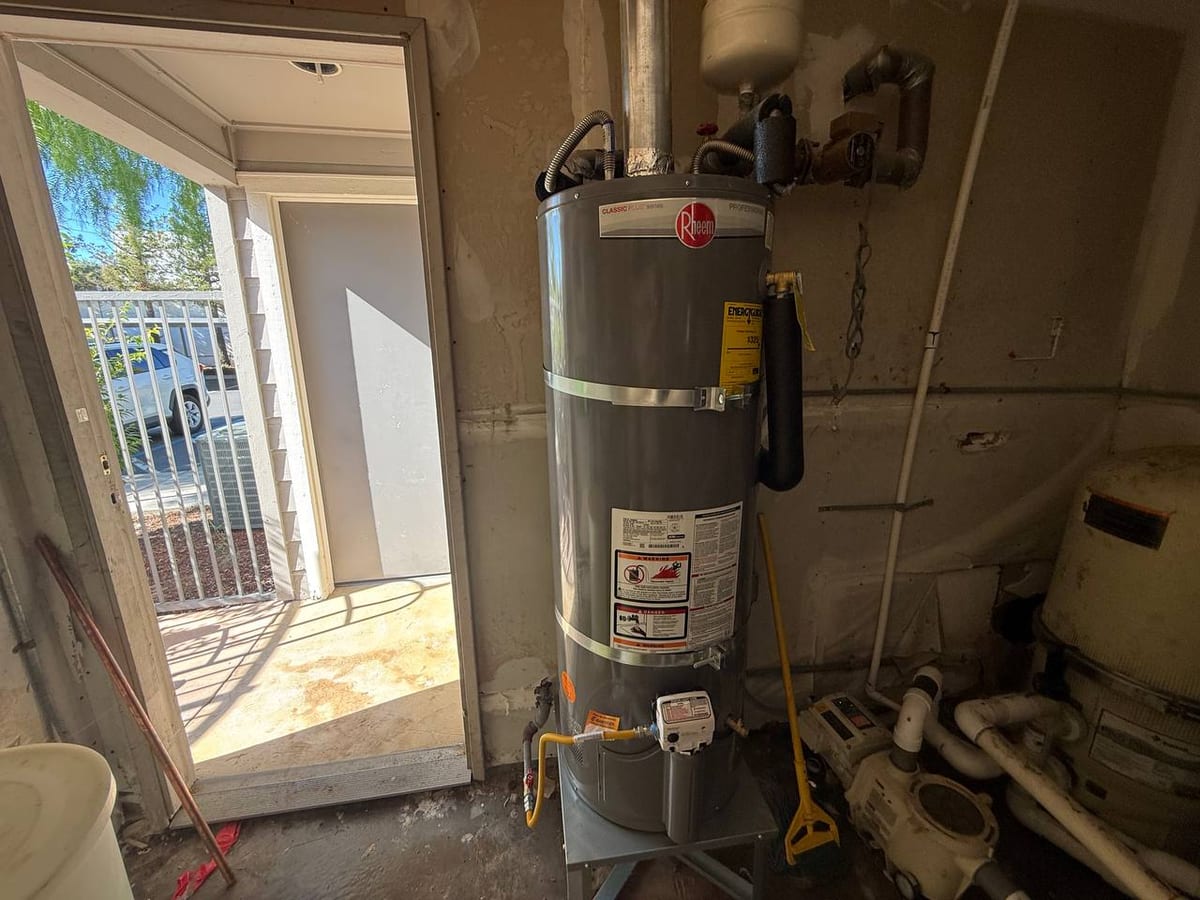
Replace a gas water heater if the tank itself is leaking, it’s past 10-12 years old, or the repair would cost more than half of what a new unit runs. Repair makes sense when a component like the thermocouple or gas valve fails on a tank under 8 years old. Tankless units last 18-20 years, tanks 10-12.
We get this call constantly: a water heater doing something it shouldn’t, not heating, leaking, making noise, shutting off, and the owner wants to know whether to repair or replace. Almost every contractor will recommend replacement (bigger ticket); almost every YouTube comment will recommend repair (cheaper short-term). The actual answer comes down to three things: age, failure mode, and cost ratio.
Age first
A modern tank gas water heater has an expected service life of 10-12 years. Tankless units run 18-20 years. After those marks, every individual component is statistically closer to failure, fix one, the next is queued.
The age check is fast: look at the manufacturer label on the side of the tank. The serial number is date-coded. Serial number date encoding varies by brand. Some use the first four digits as year + week (e.g., 2316 = 16th week of 2023); others use letter codes for the year. If you’re unsure, search [brand name] serial number date decoder or send us a photo of the label. A serial that decodes to 2023 is a young tank, repair-friendly. One that decodes to 2012 is 13 years old, replace.
If you don’t know the age, you’re already at the question: replace.
Failure mode second
What’s actually wrong with the unit determines whether repair is even on the table.
Tank leaking from the bottom → the tank itself has failed. Water is coming through the steel shell, usually from corrosion that started invisibly years ago. There’s no fix for this. Replace before you find out how much water damage the leak creates.
Tank leaking from the top → usually one of the threaded fittings (inlet, outlet, T&P valve), repairable.
Pilot keeps going out / no ignition → could be the thermocouple ($30 part), the gas valve ($150-300 part), the pilot tube, or a venting issue. All repairable, depending on age.
Insufficient hot water → could be sediment buildup at the burner (flush the tank, often free), a thermostat issue (repair), or the tank is undersized for the household’s current use (replace with a larger unit).
Loud rumbling/popping noises → sediment on the burner causing the water at the bottom of the tank to flash to steam in pockets. Flush the tank. If the noise persists after a flush, the burner assembly is fouled or corroded and repair gets expensive fast.
Discolored water → corroded anode rod (cheap repair) or corroded tank lining (no repair, replace).
Cost ratio third
Once the failure mode points at a repair, the math: if the repair costs more than 50% of what a replacement would cost, replace instead. A $400 gas-valve repair on a 13-year-old tank doesn’t make economic sense when a $1,800 replacement gets you another 10-12 years and resets the warranty clock. A $400 gas-valve repair on a 4-year-old tank is the obvious right call.
The 50% threshold is rough; we usually walk through the specific math with the homeowner because individual numbers move it. Equipment warranty status matters (parts under factory warranty are free, only labor cost is real). Tank size matters (the 50-gallon-to-75-gallon upsize for a growing family is sometimes the right reason to replace a still-functional unit).
What “replacement done right” actually includes
If you’re going to spend the money, here’s what the install should cover:
- Code-compliant gas shutoff valve: quarter-turn ball valve, not the old globe-style. Required when the appliance is replaced; commonly skipped on cheaper bids.
- T&P (temperature and pressure) relief valve with proper discharge piping to a safe termination point.
- Seismic strapping at the upper and lower thirds of the tank. California code requires it; older installs often don’t have it.
- Vent connector inspection and adjustment: confirm draft is correct for the new unit’s specs.
- Permit and inspection: yes, even for “just a water heater swap.” Permit fee is modest; the value is a paper trail when you sell the house.
- Leak testing of all gas and water connections before commissioning.
The $1,500 bid that “doesn’t include any of that” is real, and we see the consequences a year or two later when a different problem brings us back to that house and we have to fix the original install before doing the new work.
Tankless or stay with tank?
If you’re already replacing, this is the right moment to ask the question. The factors that push toward tankless:
- Multiple bathrooms running simultaneously (tankless never runs out)
- You’re planning to stay in the home 7+ years (recovery time on install cost)
- You want the floor space back in the utility room
- You value the energy efficiency (condensing tankless beats tank on standby losses)
Factors that push toward staying with a tank:
- Single-bathroom or low-simultaneous-demand household (tankless overkill)
- Existing gas line undersized for tankless gas demand (gas line upsize adds $1,000-2,000)
- Hard-water area without intent to descale annually (tankless heat exchangers scale faster than tank elements)
- Shorter ownership horizon (install cost won’t pay back)
Both are good products. The right choice is the one that matches your household and your house, not the one the contractor pushes hardest.
Bottom line
Repair-vs-replace on a water heater is an age + failure-mode + cost-ratio call. Most well-trained contractors will give you the math honestly if you ask for it. We will. If you want a second opinion on a repair quote you already have, we’re happy to do the diagnostic and tell you what we’d recommend, even if the recommendation is “the repair you’re being quoted is the right call.”
Key takeaways
- If the tank itself is leaking, repair is not on the table, the tank has failed and water damage is the next event.
- If the gas valve, thermocouple, or heating elements have failed on a unit under 8 years old, repair is usually right.
- Tanks over 10 years old should not get expensive single-component repairs, the next component is queued up behind this one.
- Modern tank gas water heaters last 10-12 years on average; tankless units 18-20 years.
- California seismic strapping and current-code shutoff valves are required whenever the appliance is replaced, bidders who skip these are cheaper for a reason.
Related questions
How old is my water heater?
Is a tankless worth the upfront cost?
What's the difference between a $1,500 and a $3,500 water heater install bid?
My water heater is leaking from the top. Is it dead?
What's a 'flue blockage' and is it dangerous?
Need help with your system? Call (925) 999-4095 or book a visit. Repair diagnostics are $99, credited toward the repair. Installation assessments are free.
Further reading
Need HVAC help in the Bay Area?
We serve 56 cities. Same or next day when we can.
Bay Area · 7am–7pm · 7 days · no overtime charges