
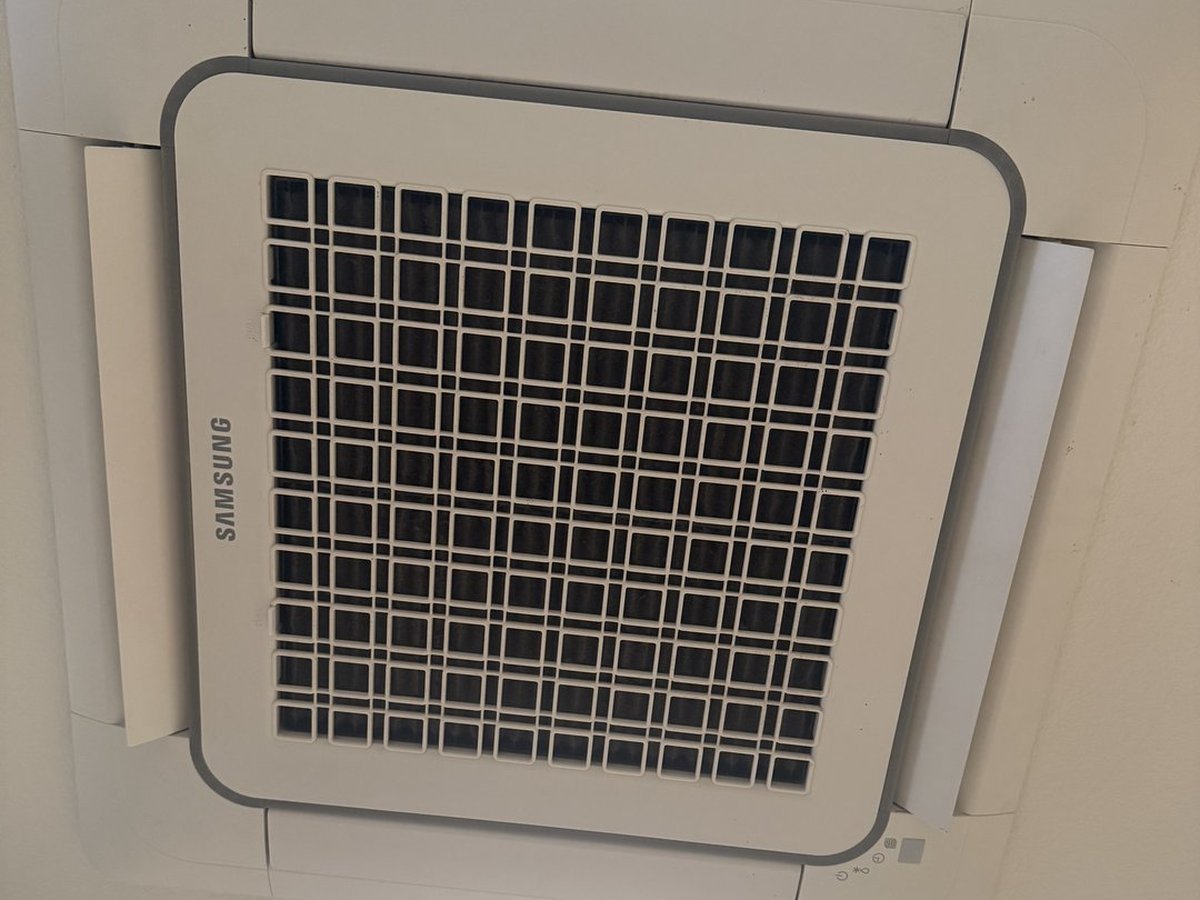
If your AC is running but not cooling, and you can see ice on the indoor coil or the copper refrigerant line outside, the system has a freezing problem. This is the single most common AC service call we get from May through August. Running a frozen system damages the compressor, so don’t ignore it. We diagnose the fault on site, then provide a written repair estimate and timeline.
First step: turn cooling off, fan on
Before anything else, switch the thermostat to OFF on cooling and turn the fan setting to ON. The blower keeps moving room-temperature air across the frozen indoor coil and thaws it safely. Running cooling while the coil is iced up pulls liquid refrigerant back to the compressor instead of vapor; that wears the compressor fast and is the most expensive failure mode on the system.
Wait 1 to 4 hours for full thaw, depending on ice volume. Set a towel under the indoor unit; melted ice can be a couple of gallons.
Five most common causes
1. Airflow restriction (most common)
Anything that blocks air across the evaporator coil drops coil temperature below 32°F. The usual suspects:
- Dirty air filter. Check this first. If it’s gray or you can’t see light through it, replace it. A clean filter sometimes resolves the whole thing.
- Closed or blocked registers. Closing too many registers in unused rooms restricts return airflow. Open them.
- Collapsed flex duct. Common in attics where ducts kink against framing. A tech spots these on inspection.
- Dirty evaporator coil. Coils accumulate dust and film over years, cutting airflow noticeably. Cleaning requires a foaming cleaner and safe access; it’s a pro job.
- Failed blower motor or capacitor. A motor running below rated speed won’t move enough air. This needs electrical diagnostic and the right parts.
2. Low refrigerant
Refrigerant doesn’t get consumed in normal operation. If pressure is low, there’s a leak. Lower pressure drops the coil’s saturation temperature below freezing.
A tech connects manifold gauges to the refrigerant ports, reads suction and liquid line pressures, calculates superheat and subcooling, and pinpoints the leak. Common leak locations: evaporator coil seams, line set fittings, condenser coil end-cap brazing, Schrader valve cores. Finding and fixing a refrigerant leak requires EPA 608 certification and recovery equipment; it’s not a DIY job.
Repair cost depends on refrigerant type. R-410A leaks: roughly $400 to $1,200 for repair and recharge, varies by leak location and amount. R-22 (phased out): refrigerant cost alone often makes repair uneconomical.
3. Dirty evaporator coil
The indoor coil collects dust and biological film over years. Even a half-millimeter buildup measurably restricts airflow and lowers heat transfer. Coil cleaning uses a foaming non-acid cleaner and needs proper access; when it’s done right, the system regains normal airflow and pressure.
A spring AC tune-up that includes coil cleaning typically catches this before it causes a freeze.
4. Low ambient temperature
Bay Area shoulder-season weather (April to May and October to November) can put outdoor temps in the 55 to 65°F range. Most ACs aren’t designed for that. If your AC freezes only on cool evenings and runs fine on hot days, this is likely your cause.
The fix is a thermostat with a low-temp lockout, or simply not running cooling below 65°F outdoor temp. Heat pumps with proper controls handle this better because they cycle differently in shoulder season.
5. Failed blower motor or capacitor
Blower motors that are about to fail run slower than rated. Slower blower means less airflow means frozen coil. If airflow from the registers feels noticeably weaker than last summer, that’s a warning sign. A capacitor or motor swap is quick work for a tech with the right parts and a safe electrical shutdown; it’s not something to attempt without training.
What we do on a freeze call
A typical diagnostic visit:
- Confirm system is off and coil is thawed (or thawing).
- Inspect filter, registers, and accessible ducts.
- Inspect indoor coil for dust buildup.
- Connect manifold gauges; read suction and liquid pressures, calculate superheat and subcooling.
- Check blower motor amperage and capacitor capacitance against spec.
- Identify root cause (some calls have more than one).
- Written estimate before any repair work.
Diagnostic is $99, credited toward any repair.
When freezing means replacement
Three cases where we’ll walk through replacement instead of repair:
- System is on R-22 refrigerant and has a leak. Reclaimed R-22 cost makes repair uneconomical.
- System is past 15 years and this is the third or fourth significant repair.
- Indoor coil is cracked, and replacement coil cost approaches half of a new system.
We run the numbers at the estimate. We don’t push replacement when repair makes sense, and we won’t quote a repair on a system that’ll fail again next summer.
Call us
If your coil is iced up and the filter isn’t the problem, call us at (925) 999-4095. We cover Danville, San Ramon, Alamo, and the surrounding Tri-Valley and East Bay. Same or next-day service most days; we’ll tell you the window when we book it. Diagnostic is $99, credited toward the repair. CSLB #1136642.
Related reading
- Repair or replace your HVAC, how I decide on the job
- Heat pump installation cost in the Bay Area
- Heat pump or gas furnace, 2026 decision guide
Key takeaways
- Frozen AC coil is almost always one of five causes: airflow restriction, low refrigerant, dirty coil, low ambient temperature, or blower failure.
- First step: turn cooling OFF, switch the fan to ON so the blower thaws the coil safely. Don't run the system again until a tech inspects it.
- Running a frozen system damages the compressor; do not keep cooling on while ice is visible.
- Most fixes are straightforward repairs in the $150 to $500 range; refrigerant leaks can run higher.
- If your system is on R-22 refrigerant and has a leak, replacement usually wins on lifetime cost.
Related questions
Should I keep running my AC if it's iced up?
What's the most common cause of AC freezing up?
Could it be low refrigerant?
Can outdoor temperature cause AC freezing?
How much does it cost to fix a frozen AC?
Need help with your system? Call (925) 999-4095 or book a visit. Repair diagnostics are $99, credited toward the repair. Installation assessments are free.
Further reading
Need HVAC help in the Bay Area?
We serve 56 cities. Same or next day when we can.
Bay Area · 7am–7pm · 7 days · no overtime charges