
The dollar threshold: roughly $3,000
A common rule of thumb says: if the repair costs more than half the value of the system, replace it. For HVAC, that maps to about $3,000 in practice. Below $3,000 on a system that’s still working, repair almost always wins. Above $3,000, you start running the replacement numbers, especially if the equipment is old or holds an outdated refrigerant.
The threshold shifts when heat pump rebates are on the table. We work with BayREN, MCE, PG&E, EBCE/Ava, and manufacturer instant rebate programs. The 2026 stack is smaller than 2024 (Tech Clean California and federal 25C are both closed), but the active programs are still enough to move the math on systems that are near end-of-life. We confirm what’s actually paying when we write your estimate.
Age matters more than runtime hours
Predictable lifespans for HVAC equipment: central AC 15 to 20 years, gas furnaces 15 to 25, heat pumps 15 to 20. These aren’t hard rules. They’re failure-probability curves. A system at 18 years isn’t broken yet, but the compressor, heat exchanger, and control board are all in the zone where the next big repair tends to land.
Practical rule I use on calls: if the system is 15-plus years old and needs a repair over $500, run the replacement numbers. The repair might buy two more years. It might also fail again in six months.
R-22 is the hidden dealbreaker
R-22 refrigerant production was phased out in 2020. If your AC runs R-22 and has a leak, you have two choices:
- Pay $100 to $200 per pound for reclaimed R-22 to recharge a system that will leak again.
- Replace with a system that uses R-410A or R-454B and qualifies for current rebates.
For most customers, the math points to replacement once R-22 is in play, regardless of the repair cost.
Safety calls overrule cost
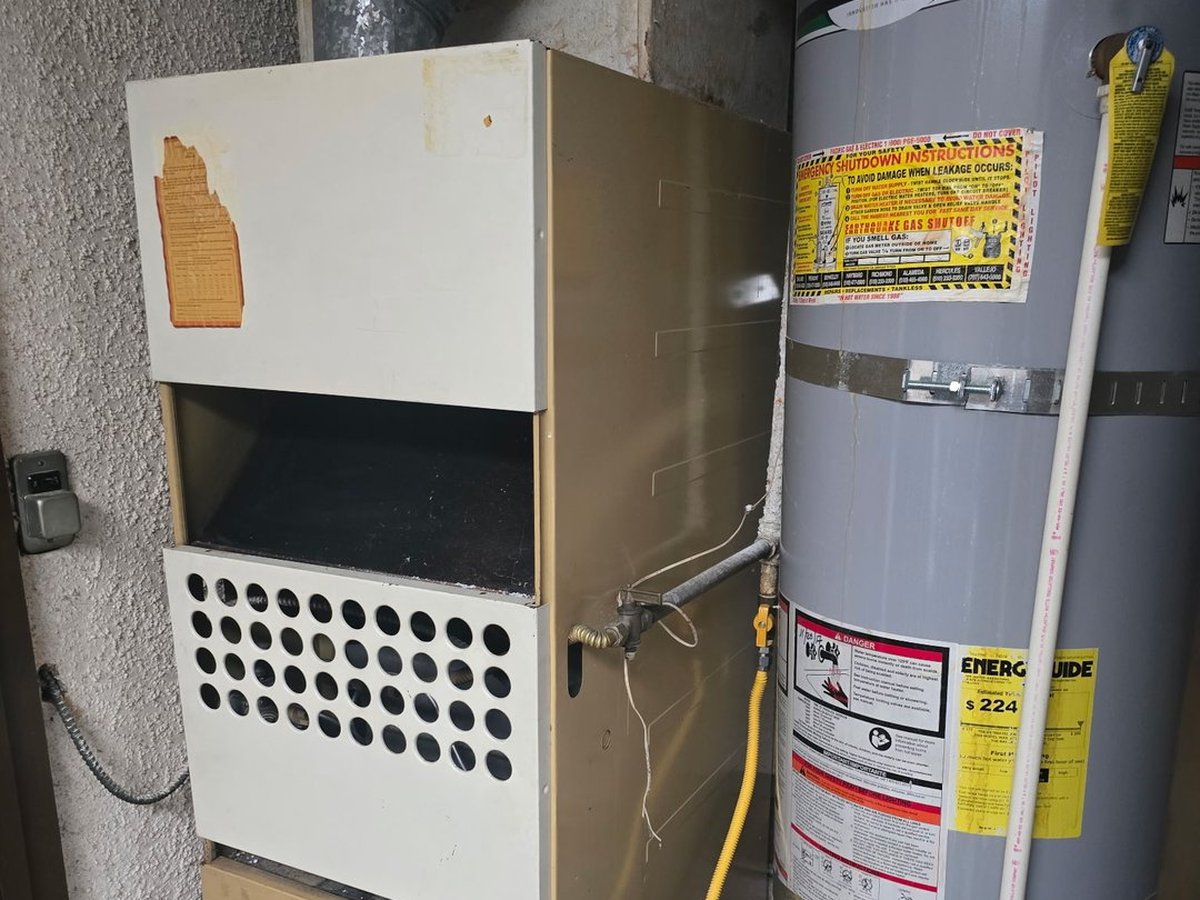
A cracked heat exchanger on a gas furnace is a carbon monoxide risk. The repair quote doesn’t matter; we recommend replacement. Same with a confirmed gas valve failure on an older system. Some calls aren’t economic decisions.
Heat pump conversion can change the picture
When the replacement option is a heat pump rather than another gas furnace, the rebates and the operating cost difference both come into play. A typical 4-ton whole-home install in Danville runs $14,000 to $15,500 before rebates. We layer BayREN, MCE Heat Pump HVAC, PG&E, EBCE/Ava, and manufacturer instant rebates onto qualifying installs, out-of-pocket depends on which programs are funded for your address at the time of install. Compared with another round of $1,500 to $3,500 repairs on an aging system that will fail again, the replacement math often gets attractive.
Note on programs you may see in older articles: federal Section 25C expired December 31, 2025 and Tech Clean California is on full waitlist as of November 14, 2025. Neither is paying out new applications for 2026 installs.
I walk customers through this math on every estimate where replacement is a realistic option. We don’t push replacement as the default. We give you the numbers and let you decide.
A Package-Unit Install, On Camera
Key takeaways
- Repair under $3,000 on a working system is usually the right call.
- Equipment that's 15-plus years old or runs R-22 refrigerant pushes toward replace.
- Cracked heat exchanger on a gas furnace: replace. That one's not a cost question.
- A heat pump conversion plus current rebates can change the math even on lower-cost repairs.
- Always get a second written opinion on any replacement quote over $10,000.
Related questions
My AC is 15 years old. Repair or replace?
When should I replace instead of repair my furnace?
What is R-22 refrigerant and why does it matter?
How do I get a second opinion on a replace quote?
Need help with your system? Call (925) 999-4095 or book a visit. Repair diagnostics are $99, credited toward the repair. Installation assessments are free.
Further reading
Need HVAC help in the Bay Area?
We serve 56 cities. Same or next day when we can.
Bay Area · 7am–7pm · 7 days · no overtime charges